In Eat Me, director Aïda Gabriëls takes on the question of when never enough becomes too much. Spoiler: no answer arrives. As so often, it is not about the outcome, but the path towards it. Expect a journey through a musical banquet that moves between baroque and techno, drawing the audience in. Because do we not all, quietly, want more?
A chef, a performance artist, a critic and a hostess (and former opera singer) circle a table. It sounds like the beginning of a joke, but the punchline never comes. What is left to laugh about when the food does not arrive? Eat Me traces what it means to keep longing for more. Does it ever stop, or is desire inherently insatiable?
The starting point was the cult film La Grande Bouffe, in which four men retreat to a country house, determined to eat themselves to death as a final protest against consumer culture. “I wanted to examine where we stand today,” says Gabriëls. “We keep producing, also in the arts. That is simply how it works, but the question is how we position ourselves within that system.” The reference lingers in the wings, yet here there is no end point, no fatal saturation. No death by excess. Here, there is nothing left to consume, and yet the body continues. We remain seated. We keep watching. We keep saying yes. Without judgement, but without escape, Eat Me draws a circle in which no one escapes.
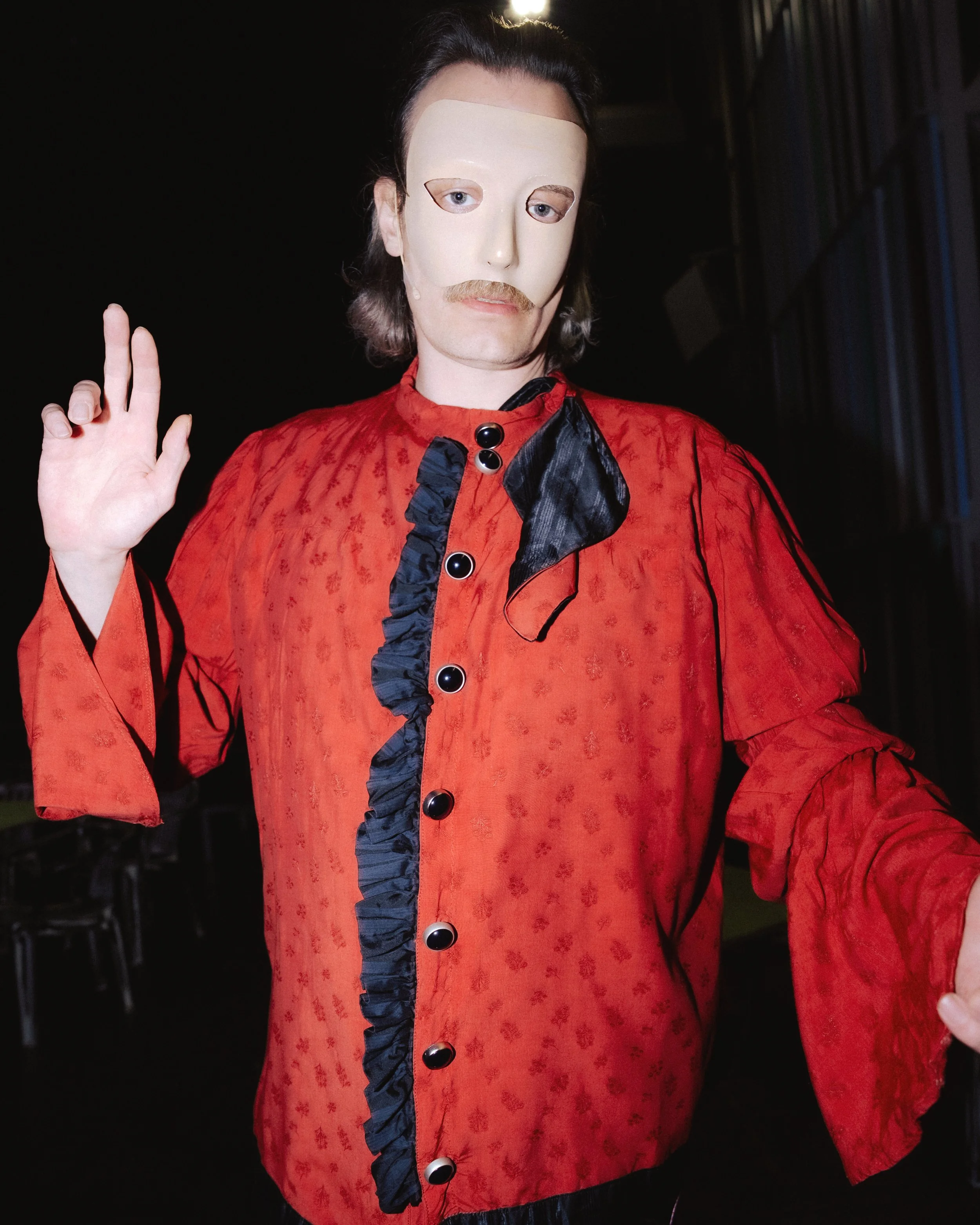
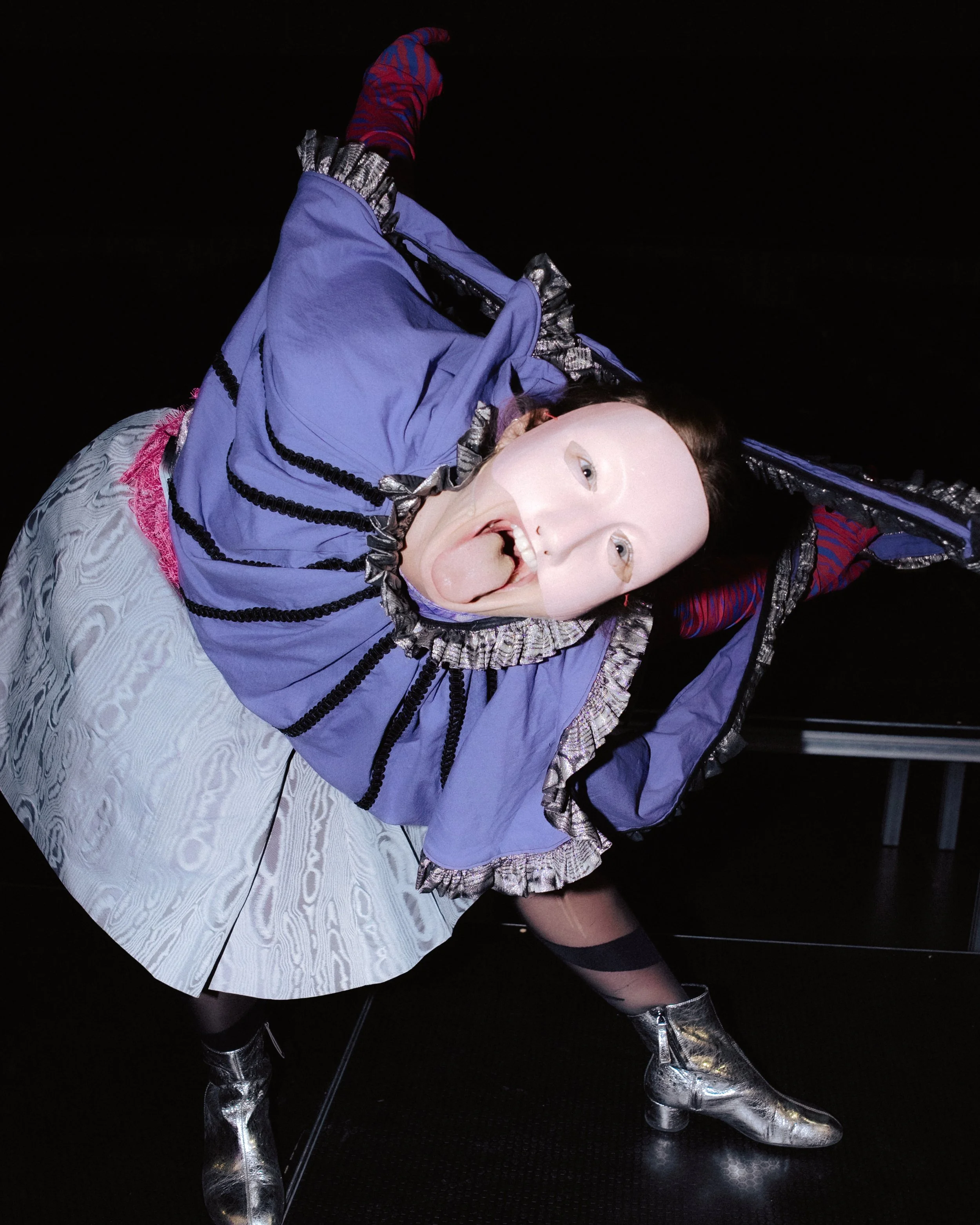
Together with writer and poet Dominique De Groen, Gabriëls assembles a tableau of four figures who function more as roles than as characters. The libretto unfolds as an open score in which performers test and shift their positions. Blandine, the hostess, safeguards the form: her politeness is not a resting point but a motor that organises, accelerates and sustains everything. The former opera singer speaks in echoes, consumed by her own roles until only quotations, gestures and poses remain. Gaspard, the chef, pursues an unattainable perfection, narrowing the world into a single endless act that exhausts him. Cindy, the performance artist, tilts the gaze, exposing what prefers to remain smooth, while still participating in what she unsettles. Claus seeks ground in analysis, entangling himself in a continuous stream of questions that mainly reaffirm his own position. Beneath it all: a fifth, unnamed presence, a hand without an owner, shifting the accents.
Doomscrolling
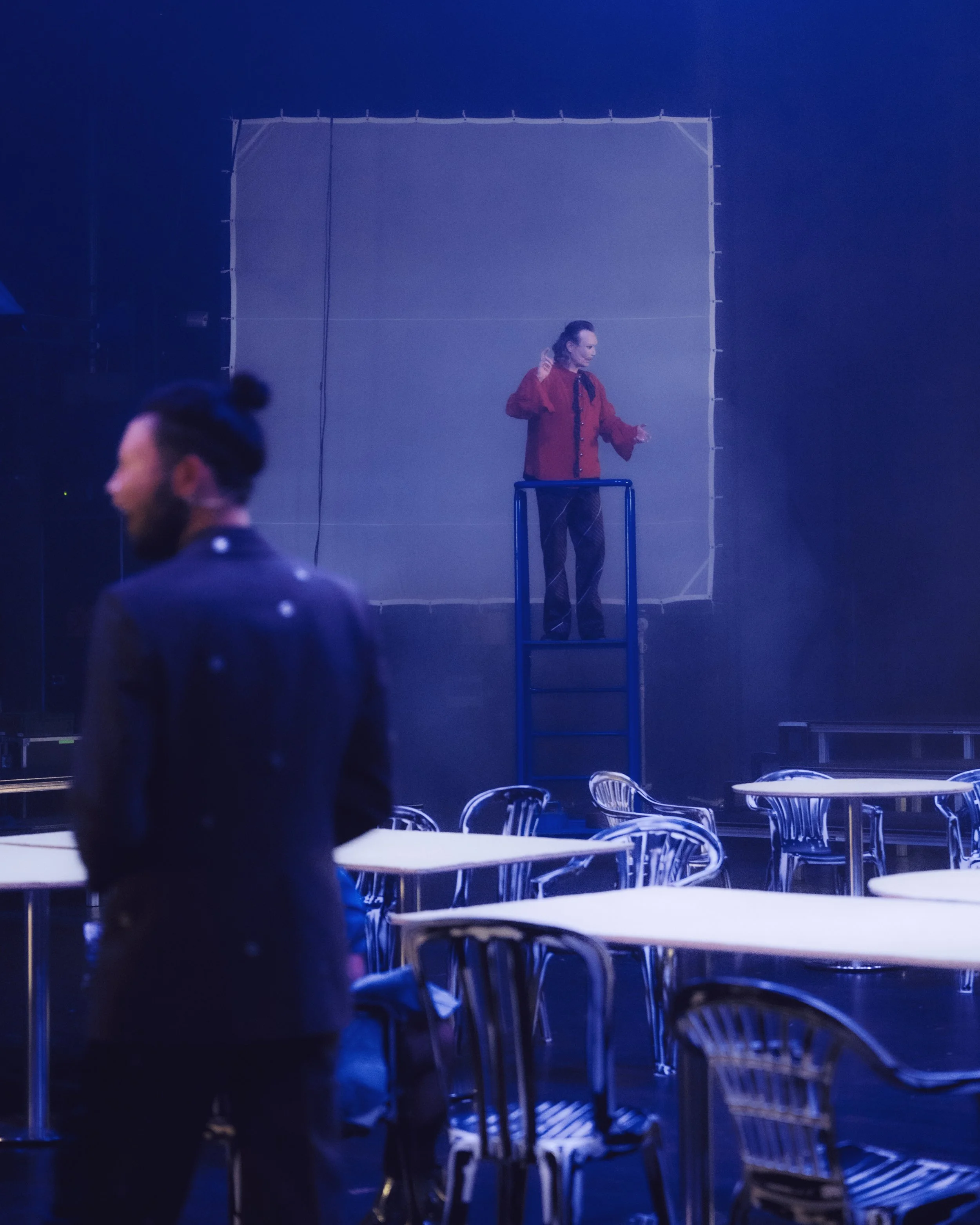
The quest takes the form of a musical banquet in which the audience also takes a seat. By now, this is almost vintage Gabriëls: her work often assigns a role to the spectator. “There are anonymous stands, but there is also room at the table for forty guests. We are all part of the system. No one is innocent, and everyone sometimes feels the urge to step out.” Yet the intention is not to send the audience home burdened, clarifies Linde Carrijn, who plays the performance artist.
“Theatre is not the place to point fingers. We want people to experience how they relate to this question. The world is on fire. What role remains for art?” For Carrijn, the answer is double. “I consume just as happily, or catch myself doomscrolling. At the same time, I think about what I eat, and what I can change.” Whether that is enough remains open. “The cliché of the privileged artist living off subsidies is an easy one. I defend what I do, but many do not understand it. That tension is part of the work.” Eat Me also marks a step into less familiar territory for Carrijn. As an actress, she has long combined music and theatre, but performance in a more installation-like context is new. “Aïda creates performances as environments. The set-up forces us to perform in 360 degrees, which is more complex than a frontal approach. Our roles are not fully written out either. Through improvisation, we search for images together. It is a real challenge.”
The drop of the baroque
And the music? Baroque was almost inevitable. “It is the art of excess,” says Gabriëls, “but I wanted to give it a contemporary twist, and turn it into a musical journey between two extremes.” A five-piece B’Rock Orchestra performs repertoire with harpsichord, whose basso continuo sits surprisingly close to electronic structures. This led Gabriëls to theatre composer Jonathan Bonny, who discovered that baroque and techno share more than expected. “Baroque has always been my favourite period, but only now do I realise how much it has in common with electronic music: the same harmonic simplicity, the same predictability. The ‘drop’ in techno is not so different from the tension of the dominant resolving into the tonic.”
The combination holds, Bonny believes. “It creates even more excess. The audience may feel overwhelmed, but that is also the logic of a banquet. Thematically, it fits: Eat Me asks when never enough becomes too much. For me, it is about how far I can go, and how hard I can let techno pulse through baroque.”
A Lynchian ending
For the scenography, Gabriëls collaborated with the Brussels-based duo :mentalKLINIK, who elevate the iconic monobloc garden chair, born from twentieth-century mass production and a symbol of modest pleasure, into design. Eat Me does not move towards catharsis. The question of whether the system can be broken, and whether it is ever truly enough, remains open. “That is a risk,” Gabriëls says, “but I prefer to end as in a Lynchian world: without closure. Hunger remains. Hunger will always remain, even beyond indigestion.”
The aftermath of a party. The guests are too early, or perhaps just too late. As the space attempts to recover from what has been, the question emerges of how this gathering might end. Chairs still stand askew, traces linger of what has already been consumed. And yet everything is rearranged once more: tables and chairs, exhausted yet stubbornly upright. There is nothing left, except each other. Perhaps that is not a lack, but another measure.
Nous vous remercions de choisir, choisir, choisir, choisir, choisir, choisir, choisir, choisir.